

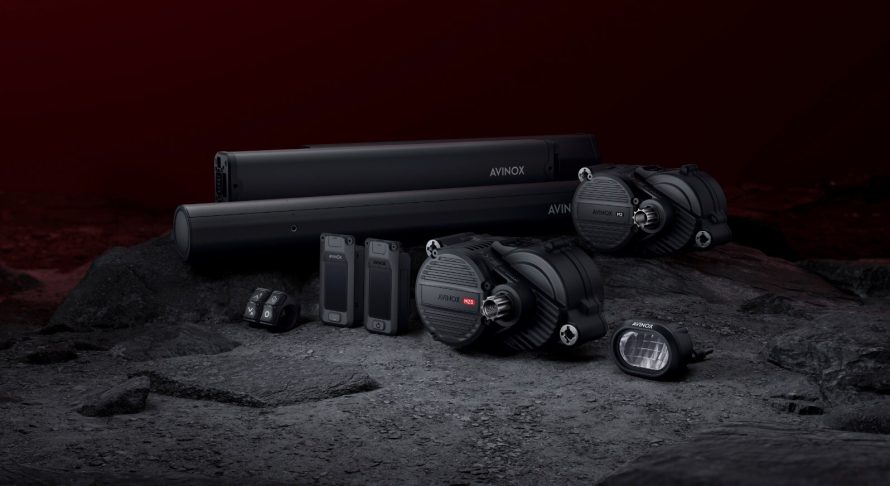

Avinox is expanding its e-bike ecosystem in a big way with the launch of the new Avinox M2S and Avinox M2 drive systems. Designed as the next step after the Avinox M1, the new platform focuses on what serious riders and bike makers actually care about: more power, better thermal control, quieter operation, broader battery flexibility, and deeper software integration. The bigger story is that Avinox is not rolling this out alone. More than 60 OEM bike brands are already working with the latest system, which gives this launch far more weight than a typical component refresh.
At a glance, the new duo targets slightly different rider profiles. The M2S clearly leans toward more aggressive performance and demanding use cases, while the M2 looks positioned as the more balanced option for riders who still want serious output without stepping all the way into the highest-spec configuration. That split makes the lineup easier to understand and gives brands more room to tune bikes around distinct use cases, from hard-charging trail builds to more versatile all-round electric mountain bikes.
A familiar compact form, now pushed further
One of the strongest parts of the original Avinox M1 was its compact size and low weight, and Avinox has kept that formula intact. The M2S weighs around 2.59 kg, while the M2 comes in at about 2.65 kg, so both stay within the lightweight territory expected from premium modern drive units. That matters because power gains are nice on paper, but they become a lot more meaningful when they arrive without a major weight penalty.
The M2S is the standout here in raw density gains, delivering a claimed 45% increase in power density and a 21.6% boost in torque density compared to the previous M1. The M2 is more conservative, but still improves power density by 4.6%. In practical terms, Avinox is showing that it is not just chasing headline wattage. It is also trying to squeeze more output into a compact package that bike designers can integrate without wrecking frame proportions or overall ride feel.
How the M2S and M2 separate themselves
The clearest difference between the two systems comes down to peak power and torque. The Avinox M2S reaches up to 1,500W of peak power, with 150Nm of peak torque and 130Nm of continuous torque. That places it squarely in high-performance territory for riders who want strong assistance on steep climbs, technical terrain, or sustained hard riding. The M2, meanwhile, delivers up to 1,100W of peak power and 125Nm of peak torque, which still sounds extremely capable for a broad range of trail and all-purpose riding scenarios.
Noise and ride refinement also get attention, because raw performance means little if the system sounds like a toolbox falling down stairs. Avinox says both systems operate at no more than 45 dBA, while the M2S uses a dual-gear meshing design to reduce gear play and pedal kickback noise. The M2 uses helical gears to cut down on rattling and knocking on rough ground. So while the M2S is the more extreme option, the M2 may appeal to riders who prioritize smoother everyday refinement alongside strong output.
The M2S also goes further in thermal management. It adds a temperature sensor, new cooling fins, and flat wire windings to improve heat dissipation and reduce energy loss. That suggests Avinox expects the M2S to be used harder and for longer periods under load, and it has built the hardware accordingly. It is one of those details that matters more in real riding than in flashy launch graphics.
Battery options finally get more flexible
Avinox is also broadening the battery story, which may be just as important as the new motors. The integrated FP700 is a 700Wh battery with 220 Wh/kg energy density and support for GaN fast charging, reaching 80% in 1 hour and 16 minutes. For riders who prefer an integrated setup and long-range capability, this looks like the core option built to unlock the full potential of the new drive units.
More interestingly, Avinox is introducing its first removable batteries: the RS800 and RS600. The RS800 offers 800Wh in a package weighing about 4 kg, while the RS600 delivers 600Wh at roughly 2.96 kg. This gives bike brands more freedom to build around different priorities, whether that means maximum range, lighter overall weight, or easier charging away from the bike. For commuters and riders living in apartments, removable batteries are not a luxury feature. They are simply more practical.
The RS600 also works as an external dual-battery option mounted to the frame, extending range for riders who go longer or harder than usual. That makes the new Avinox ecosystem feel less like a single product launch and more like a modular platform taking shape.
Displays, app features, and connected riding
On the control side, Avinox has added the DP100-F and DPC100, both 2-inch OLED full-color displays built for bad weather and messy trails. They support turn-by-turn navigation through imported routes, which can then be stored on the display for repeat use. That kind of onboard convenience matters more than brands sometimes admit, especially for trail riders who do not want to keep pulling out a phone.
Avinox is also pushing deeper into smart connectivity and ride personalization. Riders can pair a heart rate monitor and let the system adjust assist levels to stay within a target effort zone. Through the Avinox Ride App, users can tune assist level, start assist, continued assist, and max torque, while also customizing display layouts. There is even a Health Management System for fault detection and app-based troubleshooting, plus bike protection features like abnormal movement alerts and Bluetooth unlock.
One of the more useful additions is support for Apple Find My through the DPC100 display, allowing users to check location, battery level, or trigger a sound for easier tracking. Combined with compatibility across older and newer Avinox components, the ecosystem is starting to look thoughtfully interconnected rather than locked into a one-generation hardware cycle.
In the end, Avinoxis making a serious bid to become more than just another motor supplier. With the higher-output M2S, the more balanced M2, new removable batteries, smarter displays, and cross-generation compatibility, the company is clearly building a larger platform strategy around performance and flexibility. Availability begins through partner brands and business channels, while pricing has not been disclosed in this announcement. Still, with support from more than 60 manufacturers, Avinox looks set to become a much bigger name in the next phase of premium e-bike development.
| Specification | Avinox M2S | Avinox M2 |
|---|---|---|
| Drive Unit Weight | Approx. 2.59 kg | Approx. 2.65 kg |
| Peak Power | 1,500W | 1,100W |
| Peak Torque | 150Nm | 125Nm |
| Continuous Torque | 130Nm | Not specified |
| Noise Level | ≤ 45 dBA | ≤ 45 dBA |
| Gear Design | Dual-gear meshing | Helical gears |
| Thermal Features | Temperature sensor, cooling fins, flat wire windings | Not specified |
| Compatible Battery Options | FP700, RS800, RS600 | FP700, RS800, RS600 |
| Display Options | DP100-F, DPC100 | DP100-F, DPC100 |
| App Features | Route import, assist tuning, HMS, Bluetooth unlock, alerts | Route import, assist tuning, HMS, Bluetooth unlock, alerts |
| Apple Find My Support | Supported with DPC100 | Supported with DPC100 |