

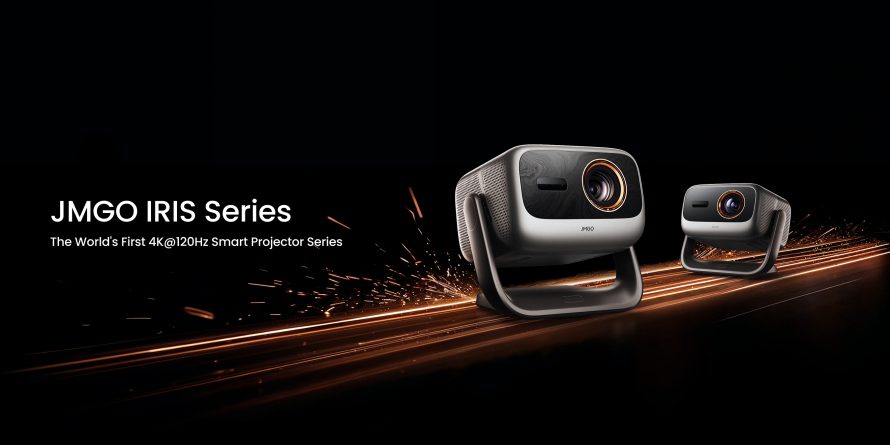

JMGO has introduced the IRIS Series globally at IFA 2026, positioning it as the first smart projector lineup capable of maintaining 4K resolution at 120Hz from input to projected output. The range includes the flagship IRIS Ultra Max and the more affordable IRIS Ultra, with both models aimed at gamers, movie fans, and sports viewers who want large-screen motion clarity without dropping to a lower resolution.
The two projectors share the same central platform, including dual-DLPC imaging, triple-laser illumination, optical zoom, lens shift, and high-refresh gaming features. The main differences appear in brightness, native contrast, and installation flexibility. That makes the decision less about basic picture compatibility and more about room conditions, placement requirements, and budget.
True 4K at 120Hz Targets Gaming and Fast Action
Many projectors accept a 4K/120Hz signal but use compromises somewhere in the imaging pipeline. According to the manufacturer, the IRIS Series maintains true 4K at 120Hz from input to output by combining a dual-DLPC architecture with the JMGO HyperPulse Actuator. The actuator shifts 480 times per second to preserve 4K detail at the higher refresh rate.
This capability matters most when displaying games running at up to 120 frames per second. Both models also support VRR and ALLM, allowing compatible gaming hardware to vary the refresh rate and automatically activate a lower-latency mode. The practical benefit should be clearer movement and more responsive control, although the announcement does not specify measured input-lag figures.
Dolby Vision is supported with 4K/120Hz content, combining high-frame-rate playback with dynamic HDR processing. For sports and movies, 4K/120Hz MEMC generates smoother motion during fast camera pans and quick action. Viewers who prefer a traditional cinematic appearance may still want to adjust or disable motion interpolation, since aggressive MEMC can make film content look unusually smooth.
Hardware-level Anti-RBE is also included to reduce the rainbow artifacts that some viewers notice with projection systems. JMGO says its implementation improves viewing comfort without introducing additional operating noise, but individual sensitivity to the rainbow effect can vary.
Ultra Max Leads in Brightness and Native Contrast
The IRIS Ultra Max is the stronger option for demanding rooms, delivering 6,500 ISO lumens and a claimed 10,000:1 native contrast ratio. Its higher light output should give it more headroom for large images, HDR highlights, or rooms where controlling ambient light is difficult.
The IRIS Ultra produces 4,500 ISO lumens with a 7,000:1 native contrast ratio. Those figures remain substantial, but its lower output makes it more suitable for users who can reduce room lighting or do not need the largest possible projected image. The press release does not provide recommended screen sizes, so buyers should avoid estimating image size from brightness alone.
Both projectors use the MALC 6.0 Triple-Laser Engine and cover a claimed 110% of the BT.2020 color gamut. JMGO also lists approximately Delta E 0.7 color accuracy. These specifications indicate an emphasis on wide color coverage and accurate reproduction, although the announcement does not state the measurement mode or calibration conditions.
A six-level Dual-Iris system lets users balance brightness and contrast for different content or lighting environments. Its 15-blade configuration is claimed to improve stray-light suppression by 11.34% compared with the company’s referenced 12-blade arrangement. AI DBL Technology additionally analyzes individual zones within each frame to improve dark-scene detail while maintaining natural-looking skin tones.
Shared Optical Adjustment, Different Placement Freedom
Both models provide a 0.88-1.7:1 optical zoom range and four-way lens shift rated at V +/-130% vertically and H +/-53% horizontally. Optical adjustment is preferable to relying heavily on digital keystone correction because it allows the projector to reposition or resize the image without discarding image data.
The IRIS Ultra Max adds an AI-powered gimbal with 360-degree pan and 150-degree tilt. This integrated movement system expands placement possibilities and can redirect the image between different surfaces without manually moving the entire projector. AI Screen Fitting can align the projection with a screen, while AI Spatial Image Memory stores projection positions and associated apps for different walls.
The IRIS Ultra retains optical zoom and four-way lens shift but is not listed with the Ultra Max’s powered gimbal or spatial memory features. It should still accommodate conventional shelf, stand, or ceiling installations, but users wanting to switch frequently between projection locations will find the Ultra Max more adaptable.
Which JMGO IRIS Projector Fits Each User?
The IRIS Ultra Max is designed for enthusiasts building a premium gaming or home-theater setup, particularly when high ambient light, flexible positioning, or stronger black-level performance matters. Its brightness and contrast advantages are meaningful, while the gimbal makes it better suited to unconventional rooms or installations using multiple projection surfaces.
The IRIS Ultra offers the more balanced value proposition. It preserves the series’ defining technologies, including 4K/120Hz projection, Dolby Vision at 4K/120Hz, VRR, ALLM, triple-laser illumination, optical zoom, and extensive lens shift. Its main limitations relative to the flagship are lower brightness, reduced native contrast, and the absence of the Ultra Max’s gimbal-based positioning system.
Pre-orders opened on September 4, 2026, with shipments scheduled to begin October 19. The IRIS Ultra Max has an early-bird price of $2,999 versus a $3,499 MSRP, while the IRIS Ultra is offered for $1,899 versus a $2,399 MSRP. Accessory and screen packages vary by model, with full offer details provided by JMGO.
| Specification | JMGO IRIS Ultra Max | JMGO IRIS Ultra |
|---|---|---|
| Resolution and refresh rate | 4K at 120Hz | 4K at 120Hz |
| Imaging architecture | Dual-DLPC with HyperPulse Actuator | Dual-DLPC with HyperPulse Actuator |
| Light source | MALC 6.0 Triple-Laser Engine | MALC 6.0 Triple-Laser Engine |
| Brightness | 6,500 ISO lumens | 4,500 ISO lumens |
| Native contrast | 10,000:1 | 7,000:1 |
| Color gamut | 110% BT.2020 | 110% BT.2020 |
| Color accuracy | Approximately Delta E 0.7 | Approximately Delta E 0.7 |
| Gaming features | VRR and ALLM | VRR and ALLM |
| HDR support | Dolby Vision at 4K/120Hz | Dolby Vision at 4K/120Hz |
| Motion processing | 4K/120Hz MEMC | 4K/120Hz MEMC |
| Optical zoom | 0.88-1.7:1 | 0.88-1.7:1 |
| Lens shift | V +/-130%, H +/-53% | V +/-130%, H +/-53% |
| Gimbal | 360-degree pan, 150-degree tilt | Not listed |
| Early-bird price | $2,999 | $1,899 |
| MSRP | $3,499 | $2,399 |
| Shipping begins | October 19, 2026 | October 19, 2026 |