

Google’s new laptop platform has moved from preorder pages to store shelves: Googlebook laptops went on sale in the United States on October 4, with five launch models from Acer, ASUS, Dell, HP, and Lenovo. All five run the same Android-based Googlebook OS with Gemini built in, so the real choice comes down to hardware: screen size, chip, weight, and whether you want a convertible or a classic clamshell.

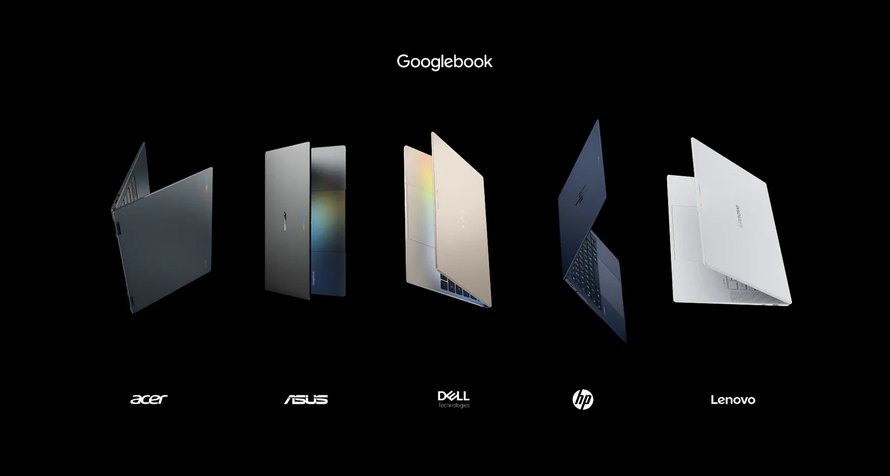
One platform, five different bodies
Every model starts with 16GB of RAM and either an Intel Core Ultra processor or a Snapdragon X Elite chip, paired with NPUs rated above 45 TOPS. The phone features are shared too. Continue On picks up a task from an Android phone, the Files app browses phone storage, and Cast My Apps streams phone apps into a desktop window. Magic Pointer brings Gemini to whatever sits on screen, while Rambler turns spoken notes into structured text.
That shared base means a buyer is not betting on different software depending on the brand. The split shows up in the chassis and the spec sheet, where the five machines are noticeably different.
Where each model fits
The Acer Googlebook 14 is the only convertible in the group, with a 14-inch OLED panel that folds back into tablet mode, which suits anyone who wants to read, present, or take notes with the keyboard folded away. Dell’s XPS Googlebook goes the other way, pairing a 13.4-inch IPS LCD with a Snapdragon X Elite chip and a starting weight of 2.2 pounds for people who mostly travel.
The ASUS Googlebook 14 is the lightest at 2.18 pounds and adds a 120Hz OLED, two Thunderbolt 4 ports, and HDMI 2.1b, building on the specs covered in our earlier look at the ASUS model. HP’s Googlebook 14 is a Snapdragon machine with a 3K OLED, a 5MP IR camera, and support for two UHD monitors. Lenovo’s Googlebook 15 is the big-screen option, with a 15.3-inch OLED for spreadsheets and split-screen work.
What the spec sheets leave open
Battery figures need a careful read. Google quotes up to 14 hours of video and 16 hours of web browsing across the platform, while individual model listings run as high as 19 hours for HP and 18 hours for ASUS and the XPS. Those come from different tests, so they are not a fair head-to-head until independent results arrive.
The phone tricks also come with limits. ASUS notes that the Android features need a phone running Android 17 or later, and several Gemini tools require an internet connection, an adult account, and a supported country and language. Without an Android phone, buyers still get desktop Chrome and the Play Store, but they lose the main reason this platform exists.
Launch lineup at a glance
The full lineup is listed on the Google Store, and every Googlebook includes 12 months of Google AI Pro with 5TB of cloud storage plus up to 10 years of updates. Prices start at $899 for the Acer Googlebook 14 at the Google Store and Best Buy, $999 for the XPS Googlebook, and $1,099 for the Lenovo Googlebook 15 at Best Buy, where the Google Store lists $1,149. The ASUS Googlebook 14 is $1,299 at the ASUS Store and Best Buy, and HP says its Googlebook 14 starts at $1,199.99 at HP.com and Best Buy in October.
| Model | Description |
|---|---|
| Acer Googlebook 14 | Convertible 2-in-1 with a 14-inch 2880 x 1800 OLED, Intel Core Ultra 5, 16GB RAM, 512GB storage, up to 16 hours of battery, 2.5 lbs |
| ASUS Googlebook 14 | Clamshell with a 14-inch 3K 120Hz OLED, Intel Core Ultra 5 325, 16GB RAM, 512GB storage, 70Wh battery rated up to 18 hours, 2.18 lbs |
| Dell XPS Googlebook | Clamshell with a 13.4-inch 2560 x 1600 IPS LCD, Snapdragon X Elite, 16GB RAM, 512GB storage, up to 18 hours of battery, from 2.2 lbs |
| HP Googlebook 14 | Clamshell with a 14-inch 3K OLED touch display up to 120Hz, Snapdragon X Elite, 5MP IR camera, quad speakers, up to 19 hours of battery |
| Lenovo Googlebook 15 | Clamshell with a 15.3-inch 2880 x 1800 OLED, Intel Core Ultra 5, 16GB RAM, 512GB storage, up to 13 hours of battery, 2.8 lbs |