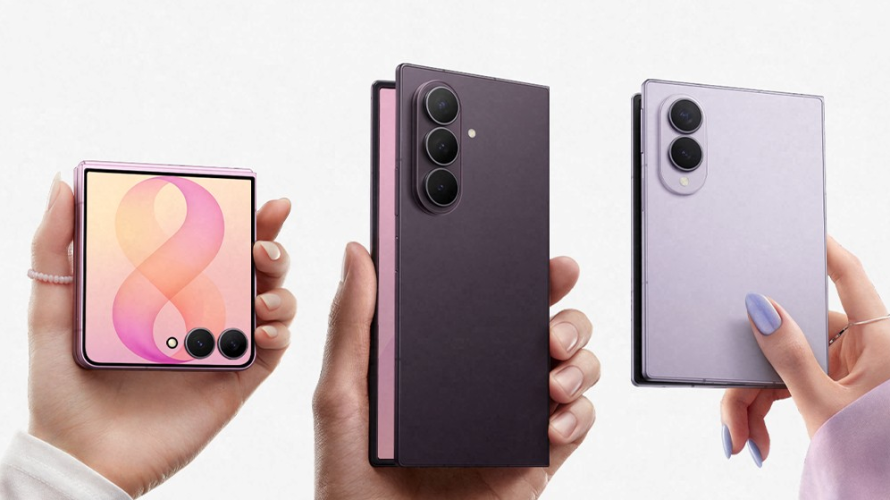
Samsung has expanded its foldable phone family with three distinctly different models: the Galaxy Z Fold8 Ultra, Galaxy Z Fold8 and Galaxy Z Flip8. Instead of treating foldables as a single premium category, the new lineup separates them into devices for high-end productivity, immersive entertainment and compact everyday interaction.
All three phones run Android 17 with One UI 9 and integrate Galaxy AI features adapted to their respective screen layouts. However, their display sizes, cameras, processors and battery systems reveal very different priorities. Here is how Samsung’s latest foldables compare.
Three Foldable Designs for Different Users
The Galaxy Z Fold8 Ultra sits at the top of the range with an 8-inch main display and a 6.5-inch cover screen. Despite offering the largest workspace, it measures only 4.1 mm thick when unfolded. Its 215 g weight is higher than the standard Fold8, but still relatively manageable for a phone designed to replace some tablet tasks.
Galaxy Z Fold8 takes a more compact approach. Its 7.6-inch internal screen uses an almost square 4:3 format suited to games, video, reading and side-by-side apps. The 5.5-inch cover screen is narrower, while the phone weighs just 201 grams, making it the lightest conventional Galaxy Z Fold model so far.
Galaxy Z Flip8 targets users who prefer portability over a tablet-sized workspace. It combines a 6.9-inch internal display with a 4.1-inch FlexWindow for notifications, apps, AI tools and camera previews. At 180 g and 6.1 mm thick when unfolded, it is the smallest option to carry.
Performance, Displays and Multitasking
Both Fold models use the Snapdragon 8 Elite Gen 5 Mobile Platform for Galaxy. The Fold8 Ultra starts with 16 GB of RAM on its 1 TB configuration, while 512 GB and 256 GB versions include 12 GB. Standard Fold8 offers the same storage choices, although only its 1 TB version receives 16 GB of memory.
Flip8 instead uses Samsung’s Exynos 2600 processor with 12 GB of RAM and either 256 GB or 512 GB of storage. That should still provide flagship-level everyday performance, but the Snapdragon-powered Fold models are better positioned for sustained multitasking, gaming and demanding creative workloads.
Every model supports a 120 Hz adaptive refresh rate and Vision Booster. The Fold8 Ultra has the sharpest and largest internal panel at 2,504 x 2,256 pixels, while Fold8 uses a 1,848 x 2,448 resolution. Flip8’s 1,080 x 2,520 display follows a more familiar smartphone shape. Samsung also introduces Flex Titanium technology to reinforce the folding display structure and help reduce crease visibility.
Camera Hardware Reveals the Biggest Differences
The Fold8 Ultra is clearly the camera-focused model. Its rear system includes a 200 MP main camera, a 50 MP ultra-wide camera and a 10 MP telephoto camera with 3x optical zoom. It also supports improved Nightography, 8K recording with the APV codec and Cine LUT controls for mobile video production.
Standard Fold8 has a simpler dual-camera arrangement consisting of 50 MP wide and 50 MP ultra-wide cameras. Features such as Dual Recording and My FanCam are intended to simplify content creation by recording multiple perspectives or automatically following and reframing a selected subject.
Flip8 pairs a 50 MP main camera with a 12 MP ultra-wide camera. Its advantage is not lens count but the folding design. Flex Mode, Camcorder Grip, Zoom Rocker and the cover-screen preview make it easier to capture hands-free selfies and stabilized vertical video without carrying a tripod.
Battery, Galaxy AI and Availability
Galaxy Z Fold8 Ultra has the largest battery at 5,000 mAh, followed by Fold8 at 4,800 mAh and Flip8 at 4,300 mAh. Both Fold models support 45 W wired charging and 20 W wireless charging. Flip8 is limited to 25 W wired charging and 15 W wireless charging, although every model includes Wireless PowerShare.
Galaxy AI adapts to each form factor. The Fold models emphasize split-screen workflows, drag-and-drop tools and Gemini Notebook, while Flip8 places Now Brief and Gemini Intelligence on its FlexWindow. Now Nudge can suggest actions based on conversations, and the AI Assistant Activity dashboard provides a centralized view of automated tasks.
The three phones also include IP48 water resistance, Wi-Fi 7 and Samsung Knox security. Fold8 and Fold8 Ultra support Bluetooth 6.0, while Flip8 uses Bluetooth 5.4. Samsung has opened pre-orders in select markets, although pricing was not specified in the announcement and may differ by region. Graphite and Cream are shared colors, with additional model-specific and Samsung.com-exclusive finishes available.
| Specification | Galaxy Z Fold8 Ultra | Galaxy Z Fold8 | Galaxy Z Flip8 |
|---|---|---|---|
| Main Display | 8.0-inch QXGA+, 2,504 x 2,256, 120 Hz | 7.6-inch QXGA+, 1,848 x 2,448, 120 Hz | 6.9-inch FHD+, 1,080 x 2,520, 120 Hz |
| Cover Display | 6.5-inch FHD+, 1,080 x 2,520, 120 Hz | 5.5-inch WUXGA+, 1,248 x 1,972, 120 Hz | 4.1-inch Super AMOLED, 948 x 1,048, 60/120 Hz |
| Processor | Snapdragon 8 Elite Gen 5 for Galaxy | Snapdragon 8 Elite Gen 5 for Galaxy | Exynos 2600 |
| Memory and Storage | 16 GB + 1 TB; 12 GB + 512/256 GB | 16 GB + 1 TB; 12 GB + 512/256 GB | 12 GB + 512/256 GB |
| Rear Cameras | 200 MP wide + 50 MP ultra-wide + 10 MP telephoto | 50 MP wide + 50 MP ultra-wide | 50 MP wide + 12 MP ultra-wide |
| Front Cameras | 10 MP cover + 10 MP main | 10 MP cover + 10 MP main | 10 MP |
| Battery | 5,000 mAh | 4,800 mAh | 4,300 mAh |
| Charging | 45 W wired, 20 W wireless | 45 W wired, 20 W wireless | 25 W wired, 15 W wireless |
| Unfolded Dimensions | 143.2 x 158.4 x 4.1 mm | 161.4 x 123.9 x 4.5 mm | 75.4 x 166.9 x 6.1 mm |
| Folded Dimensions | 72.8 x 158.4 x 8.9 mm | 81.9 x 123.9 x 9.7 mm | 75.4 x 85.7 x 13.1 mm |
| Weight | 215 g | 201 g | 180 g |
| Water Resistance | IP48 | IP48 | IP48 |
| Operating System | Android 17, One UI 9 | Android 17, One UI 9 | Android 17, One UI 9 |
| Connectivity | 5G, Wi-Fi 7, Bluetooth 6.0 | 5G, Wi-Fi 7, Bluetooth 6.0 | 5G, Wi-Fi 7, Bluetooth 5.4 |
| Colors | Graphite, Cream, Violet Shadow, Green Shadow | Graphite, Cream, Lavender, Pistachio | Graphite, Cream, Pink, Mint |