At MWC 2026 in Barcelona, Lenovo introduced a new generation of adaptive AI devices designed for business professionals, creators, students, and gamers. The announcement signals Lenovo’s broader vision of personal computing where devices intelligently adapt to users rather than forcing users to adapt to technology. The showcase includes modular PC concepts, glasses-free 3D laptops, foldable gaming handhelds, and the rollout of Lenovo Qira — a system-level AI designed to unify the user experience across multiple devices.
According to Lenovo, the next phase of computing will be defined by connected AI ecosystems and intelligent system integration rather than individual devices. This approach connects PCs, smartphones, tablets, and wearables into a seamless environment where tasks and workflows move naturally between devices. The company’s MWC showcase highlights how hardware innovation combined with system-level AI can reshape the way people work, create, and play.
Lenovo Qira and the Rise of Ambient AI
One of the most important announcements at the event is Lenovo Qira, a system-level platform built around Personal Ambient Intelligence. Unlike traditional AI assistants that operate as standalone apps, Qira is embedded directly into Lenovo and Motorola devices, allowing it to operate across PCs, tablets, smartphones, and wearables simultaneously.
The goal of Lenovo Qira is continuity. Users can begin tasks on one device and seamlessly continue them on another while the system intelligently understands context and intent. Initial rollout will support more than 20 Lenovo devices across the Yoga, IdeaPad, Legion, and ThinkPad product families, with language support spanning multiple global regions. The AI platform will continue expanding throughout 2026, including future integration into Motorola smartphones.
ThinkBook Modular AI PC Concept
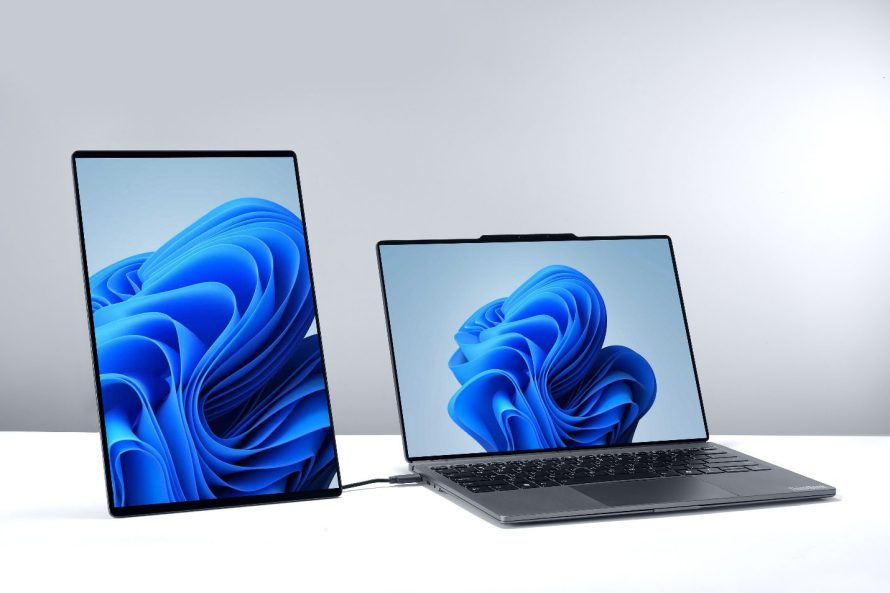
Among the most intriguing ideas presented by Lenovo is the ThinkBook Modular AI PC Concept. The system explores a modular architecture built around the concept of “carry small, use big.” The base system features a 14-inch ultra-thin laptop that can connect to interchangeable displays and detachable components.
The modular system allows users to attach additional displays or even replace the keyboard with an extra screen, expanding the workspace to roughly 19 inches. This approach not only increases productivity but also extends device lifecycles, making it easier to upgrade components without replacing the entire machine.
Exploring New Computing Form Factors
Lenovo also revealed experimental concepts exploring new directions for computing hardware. One highlight is the Yoga Book Pro 3D Concept, a glasses-free 3D laptop designed for creators working with immersive content. By combining dual displays, gesture controls, and AI-powered 2D-to-3D conversion, the concept allows users to visualize depth directly on screen.
Another standout is the Legion Go Fold Concept, a foldable gaming handheld capable of transforming from a compact portable device into a larger immersive display. The system supports multiple gaming modes including handheld play, expanded screen gaming, split-screen multitasking, and desktop-style interaction.
AI-Ready Devices for Work and Everyday Use
Beyond concept devices, Lenovo also expanded its commercial and consumer hardware lineup with several AI-ready systems. The updated ThinkPad T-Series introduces improved serviceability and repairability, while the ThinkPad X13 Detachable targets mobile professionals with a lightweight tablet-style PC that includes pen support.
Additional devices include the rugged ThinkTab X11 Android tablet for industrial environments and the ThinkBook 14 2-in-1 Gen 6 designed for small and medium businesses. On the consumer side, Lenovo unveiled new AI-powered laptops such as the Yoga 9i 2-in-1 Aura Edition, Yoga Pro 7a, and IdeaPad Slim 5i Ultra. For gaming, Lenovo introduced the Legion 7a laptop and the Legion Tab gaming tablet featuring a 3K display and advanced cooling.
The announcements reflect Lenovo’s strategy of expanding AI-powered computing across every category, from productivity devices to gaming platforms. As Lenovo continues developing its unified ecosystem, the company aims to make intelligent computing more accessible across devices and use cases. Pricing and availability will vary by device and market, with many of the announced products expected to roll out globally throughout 2026.
| Product / Concept | Description |
|---|---|
| Lenovo Qira | System-level AI platform enabling ambient intelligence across Lenovo and Motorola devices. |
| ThinkBook Modular AI PC Concept | Modular laptop with interchangeable displays and detachable components. |
| Yoga Book Pro 3D Concept | Glasses-free 3D laptop concept designed for immersive content creation. |
| Legion Go Fold Concept | Foldable gaming handheld that expands into a larger gaming display. |
| ThinkPad T-Series | AI-ready business laptops with improved repairability and lifecycle management. |
| ThinkPad X13 Detachable | Lightweight detachable PC with pen support for mobile professionals. |
| ThinkTab X11 | Rugged Android tablet designed for industrial and frontline use. |
| Yoga 9i 2-in-1 Aura Edition | Premium convertible laptop with OLED display and AI features. |
| Legion 7a | High-performance gaming laptop for immersive gameplay. |
| Legion Tab | Gaming tablet featuring a 3K display and advanced cooling system. |