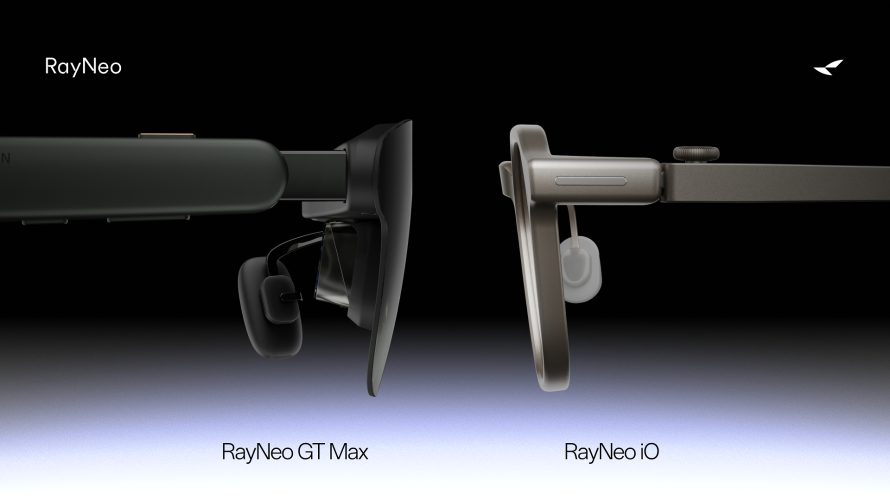
RayNeo is expanding its consumer AR portfolio with three devices designed around two very different use cases. The RayNeo iO Smart Glasses focus on lightweight, heads-up productivity, while the RayNeo GT and GT Max prioritize private-screen entertainment, gaming, and spatial viewing. This purpose-built approach avoids forcing productivity and cinematic hardware into one compromised design.
RayNeo iO Brings AI Into Everyday Eyewear
At 33 grams, the RayNeo iO is built for longer periods of wear rather than occasional entertainment sessions. Its Crown Panto-style frame combines an AZ91D magnesium-aluminum alloy body with titanium temples and balanced front-to-rear weight distribution. The result should feel closer to conventional glasses, although actual comfort will still depend on face shape and fit.
The glasses use a monochrome green Firefly Nano Engine and a diffractive waveguide with 97% optical transparency. Information appears at up to 1,300 nits of eye-level brightness, while the displayed content is designed to remain invisible to people nearby. Its 23.5-degree field of view is relatively narrow, but that makes sense for notifications, scripts, translations, and short text prompts rather than immersive graphics.
Ambient AI Focuses on Meetings and Presentations
The iO includes an Ambient AI Life Log that can retain scheduling and conversation context, identify action items after meetings, and suggest calendar updates. Users can approve supported actions with a head nod. RayNeo AI and Gemini 3.1 Flash Lite power the core experience, while an optional selection tier lets users switch among Gemini, ChatGPT, Claude, and DeepSeek through the companion app.
Live translation supports 55 languages and 109 accents with claimed latency of approximately one second. An automatic teleprompter can also adjust scrolling to the speaker’s pace. Voice capture comes from four microphones and a bone-conduction sensor, but the glasses have no built-in speakers. That visual-first design improves discretion, although users wanting audio feedback will need another connected device.
A 240mAh battery is rated for up to two days of typical use, 18 hours of continuous recording, or 6.2 hours of continuous translation. Bluetooth 5.4, Apple MFi licensing, IP54 protection, a physical Smart Crown, and a hardwired recording indicator round out the practical features. Battery figures remain manufacturer claims and will depend on how frequently the display, microphones, translation, and AI functions are used.
GT and GT Max Target Portable Big-Screen Viewing
The RayNeo GT Series takes a more entertainment-focused direction. Both models use dedicated Vision 4000 display and Zone 360 tracking chips, enabling Steady, Pinned, and Follow viewing modes. Steady Mode is particularly relevant for travel because it is designed to reduce the visual impact of bumps and turbulence, while Pinned Mode keeps the virtual display anchored within three-dimensional space.
The standard GT weighs 68 grams and offers a 46-degree field of view with a virtual display of up to 231 inches. The 78-gram GT Max expands the field of view to 59 degrees and provides three selectable screen scales equivalent to 227, 267, or 307 inches. The Max model therefore offers the more enveloping image, but it is also heavier and will likely be less discreet than the productivity-oriented iO.
Display Quality, Audio, and Choosing the Right Model
When paired with the RayNeo Pocket TV Pro, the GT Series supports native Dolby Vision playback and real-time AI conversion from SDR to HDR. Audio is delivered through four speakers co-tuned with Bang & Olufsen, accompanied by head-tracked spatial sound and a directional Whisper Mode. These features position the glasses as a personal cinema, though the release does not provide details about supported source devices beyond the Pocket TV Pro pairing.
Model selection mainly comes down to intent. The iO suits professionals who want translation, meeting assistance, and teleprompter functions without an immersive screen. The GT should appeal to users seeking lighter portable media glasses, while the GT Max trades additional weight for a wider field of view and larger perceived display. Its three physical IPD sizes also make correct sizing important before purchase.
The RayNeo iO, GT, and GT Max are scheduled to go on sale on September 4, 2026, with custom prescription lens inserts supported for both GT models. Pricing was not announced in the supplied information. All three products will also be demonstrated at IFA 2026 in Berlin from September 4 to 8, giving RayNeo a lineup spanning subtle ambient assistance and more immersive mobile entertainment.
| Specification | RayNeo iO | RayNeo GT | RayNeo GT Max |
|---|---|---|---|
| Primary Function | Ambient heads-up productivity and AI | Portable AR media and gaming | Cinema-grade AR viewing |
| Weight | 33g | 68g | 78g |
| Optical Engine | Firefly Nano Engine | Birdbath optical system | Peacock Optical Engine 3.0 Max |
| Field of View | 23.5 degrees | 46 degrees | 59 degrees |
| Display Format | Monochrome green text overlay | Virtual screen up to 231 inches | 227, 267, or 307-inch virtual screen |
| Audio | No speakers; four microphones and bone-conduction sensor | Quad speakers co-tuned with Bang & Olufsen | Quad speakers co-tuned with Bang & Olufsen |
| Tracking and Controls | Smart Crown and head gestures | Zone 360 hardware 3DoF tracking | Zone 360 hardware 3DoF tracking |
| Notable Feature | AI assistance, translation, and teleprompter | Portable spatial media viewing | Wider view, display scaling, and three IPD sizes |
| Availability | September 4, 2026 | September 4, 2026 | September 4, 2026 |